
Washington County Probate Court Role
Probate in Washington County is handled in District Court at Washington Combined Court. Colorado District Courts hear probate matters, and the statewide self-help forms identify categories such as trusts, estates and wills, abandoned estate documents, affidavits for collection of personal property, inventory and accounting, trust registration statements, guardianship, conservatorship, probate with a will, probate without a will, opening an estate, reopening an estate, and registering out-of-state orders.
The county does not have a separate local probate court office. That means probate filings, probate docket questions, copies of estate papers, and hearing questions go to the same Washington Combined Court clerk channel used for other District Court matters. Marriage licenses and recorded county documents go to the Washington County Clerk and Recorder instead, so estate-file requesters should avoid the 150 Ash Avenue county administrative office unless they need recorded documents rather than court probate records.
Washington Combined Court
26861 Hwy 34, P.O. Box 455
Akron, CO 80720
970-345-2756
Monday-Friday 8:00 a.m.-4:00 p.m.
Washington County Probate Terms
Probate records use terms that may not appear in ordinary civil cases. These definitions help separate estate administration from guardianship and conservatorship files, which often have stronger privacy limits because they can involve minors, protected persons, health information, or sensitive finances.
- Testator
- A person who made a will before death.
- Executor
- A person named in a will to carry out estate duties; Colorado forms often use personal representative.
- Intestate
- Dying without a valid will, which changes how heirs and estate administration are handled.
- Guardianship
- A court case to appoint a person to make personal care decisions for a minor or protected person.
- Conservatorship
- A court case to appoint a person to manage another person's financial affairs.
- Letters
- Court-issued proof that a personal representative has authority to act for an estate.
Search Washington County Probate Records
The online probate starting point is the Colorado Judicial Branch Docket Search. Select Washington County, Washington Combined Court, and District Court if those filters are known. Use case class PR to narrow to probate matters. Docket Search can help find hearings and case identifiers, but it is not a full probate document repository.
Official file copies, probate letters, decrees, estate papers, and certified copies should be requested from Washington Combined Court or through the Judicial Branch court-record request path. Older estate files may still require contact with the court because no separate county probate archive portal was located in the research.
- Open the Colorado Judicial Branch Docket Search.
- Select 13th Judicial District, Washington County, and Washington Combined Court when available.
- Choose District Court and use PR as the case class for probate matters.
- Search by case number, party name, attorney, or date plus another required filter.
- For documents, contact Washington Combined Court or use the court-record request route.
Washington County Probate Sources
The Colorado Judicial open an estate page explains when estate-opening paperwork may be filed.
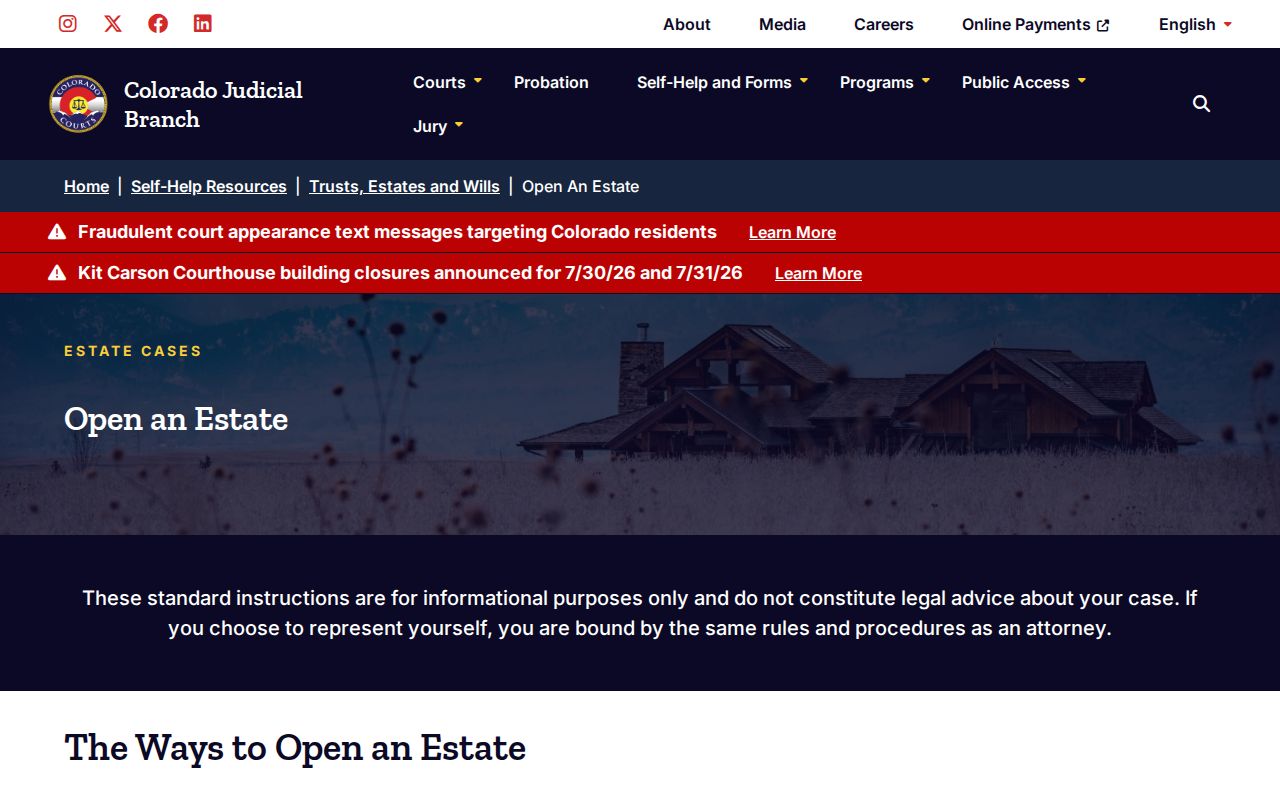
The 120-hour rule on that source is important for Washington County estate filings because the court cannot act before that period passes.
The Colorado Judicial self-help forms index is the official place to locate probate forms for estates, guardianships, conservatorships, and trusts.
Use the Judicial Branch forms by case type rather than adapting forms from another county or an unofficial source.
The Colorado General Assembly site is the official statutory source when probate law citations must be checked.
Statutes can affect filing deadlines, fiduciary duties, and eligibility, but local filing questions still route through Washington Combined Court.
Open Washington County Estate Cases
The official Colorado Judicial open-estate page says paperwork to open an estate may be filed 120 hours, or 5 days, after the decedent has died. The court cannot take action before then. A creditor who wants to file paperwork to open an estate must wait at least 45 days. Those timing rules apply to Washington County probate filings because probate is handled through Colorado District Court.
A probate filer should identify whether the matter is an estate, guardianship, conservatorship, trust registration, or small-estate collection. Venue should be confirmed before filing. If the decedent lived in Washington County, or property and venue rules point there, Washington Combined Court is the local court contact. The filer then chooses the correct Colorado Judicial Branch probate forms, files with the court, pays any required filing fee or requests a fee waiver, and follows notice, inventory, creditor, accounting, distribution, and closing duties.
| Step | Washington County probate action |
|---|---|
| Identify matter type | Estate, guardianship, conservatorship, trust registration, or small-estate collection. |
| Confirm venue | Use Washington Combined Court when Washington County is the proper county. |
| Wait before filing | Estate paperwork may be filed 120 hours after death; creditor filings wait at least 45 days. |
| Select forms | Use Colorado Judicial Branch probate forms for the specific case type. |
| Request copies | Ask Washington Combined Court for probate file copies, letters, orders, or certified records. |
Washington County Probate Fees
The research did not locate a Washington County-specific probate filing fee schedule. The Phase B rule requires researched fees only, so the fee table should not invent amounts for opening an estate, guardianship, conservatorship, letters, or certified copies. Use the Colorado Judicial filing-fee forms and confirm current amounts with Washington Combined Court before filing.
| Probate item | Researched fee status |
|---|---|
| Open estate filing | Amount not located in county research; confirm with court or Judicial Branch fee forms. |
| Guardianship or conservatorship filing | Amount not located in county research; confirm before filing. |
| Letters testamentary or administration | Amount not located in county research; request from Washington Combined Court. |
| Certified probate copy | Costs may apply, but researched county amount was not located. |
| Fee waiver | Colorado Judicial forms include fee waiver resources; eligibility depends on the filing. |
What Washington County Probate Records Show
A Washington County probate case can show the PR case number, decedent or protected person name, petitioner or applicant, personal representative, guardian, or conservator, filing date, hearing date, will status, letters, inventory and accounting filings, creditor notice, deadlines, and orders appointing a fiduciary, closing an estate, approving a final accounting, or restricting an account. A trust registration may show different fields than an estate file.
Probate records are often more open than juvenile or mental health records, but they are not unlimited public files. Guardianship and conservatorship matters can include medical or incapacity reports. Estate inventories and accountings can include sensitive financial details. Social Security numbers, protected-person data, minor information, and private account numbers may be redacted or withheld.
| Field | What it may show |
|---|---|
| Case number | Year, PR class, and sequence used to identify the probate case. |
| Decedent or protected person | Name of the person whose estate, guardianship, or conservatorship is involved. |
| Petitioner or applicant | Person asking the court to open or act in the probate matter. |
| Fiduciary | Personal representative, guardian, or conservator appointed by the court. |
| Letters and orders | Court authority to act and orders approving, restricting, or closing actions. |
| Inventory and accounting | Estate assets, financial reports, creditor claims, distributions, or protected financial data. |
Note: Probate file access depends on case type, redaction rules, party status, and any court order limiting disclosure.